Table of Contents
This year my practicum didn’t involve a classroom. No desks, no morning bell, no daily attendance.
Instead, I spent my practicum tutoring students in foster care through the Children’s Aid Society of Ottawa (CASO). The program is called Pod, and it’s completely virtual. At first, I wasn’t sure what to expect: Would it feel disconnected? Would I actually get to teach? But the experience ended up being one of the most meaningful parts of my teacher education so far.
I learned a lot about teaching, but I also learned a lot about the structure of the Ontario education system, and about how to support our most underserved students.

What Is Pod?
The Pod Model for Learning is a non-traditional practicum opportunity available to interested teacher candidates at uOttawa.
Each teacher candidate is placed in a “Pod”, a team that includes fellow teacher candidates, CASO social workers, and educational liaisons. Within each Pod, teacher candidates are assigned a list of youth in foster care whom they check in with regularly to provide one-on-one, virtual academic support.
The program was created in response to the 2020 pandemic and the closure of in-person schools, a time when the most vulnerable students became even more isolated. What began as a short-term stopgap has since evolved into a full-blown support system, currently serving over 250 students across Ottawa. Due to its success, Pod secured ongoing funding even after the return to in-person schooling.
The program’s success has also led to the founding of a second Pod program in Lanark, Leeds, and Grenville (also in partnership with uOttawa), and recently received funding to support youth entering post-secondary education. Hopefully we can see it go even further in years to come.
Pod in the News
CBC News – 2024: Program that helps at-risk youth graduate high school showing success: ‘We now know what they need,’ says program lead
CASO Media Release – 2024: Pod Model Increases Graduation Rates and Builds Trauma-Informed Classrooms
CBC News – 2021: New learning model helps at-risk youth obtain high school diploma: Children’s Aid Society of Ottawa pairs up teachers with youth in care to offer support
CASO Media Release – 2021: Pod Model for Learning Support Program
Why Pod Works for Students
Pod recognizes that students are all in different places and stages in their lives. With a trauma-informed lens, the program meets students where they’re at and supports them in taking their next step, whatever that might be. Before learning can happen, students need to feel safe, respected, and understood. Pod recognizes this. Every interaction prioritizes relationship-building first, then academics.
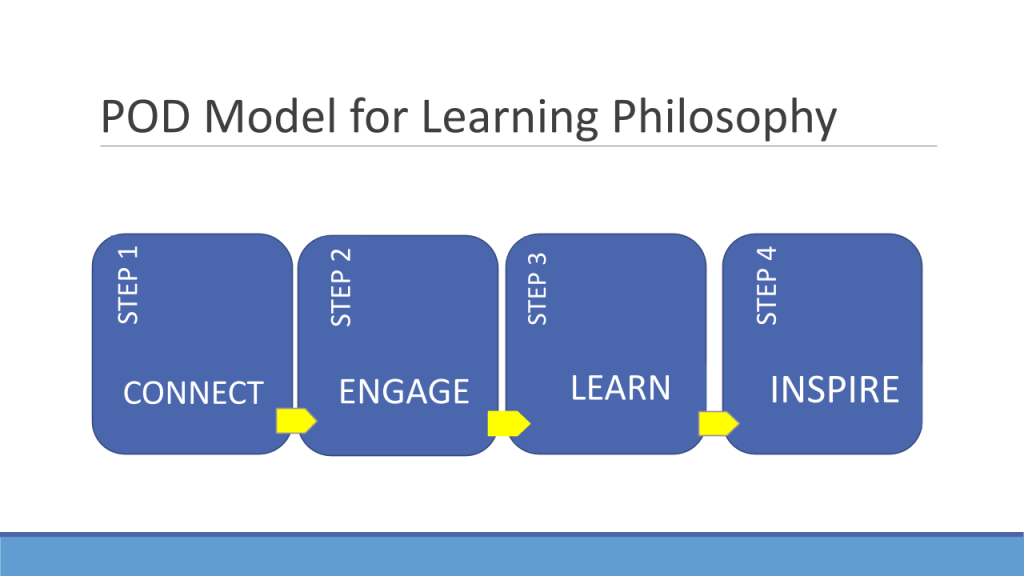
Pod is a masterclass in differentiation. Support looks different for every student, but broadly falls into one of four tiers:
- Tier 4: Strategic Intervention
These students are often very close to graduation or making a big push to accelerate their progress. Pod tutors may meet with them several times a week. - Tier 3: Moderate Support
Students in this tier typically meet with a Pod tutor weekly or bi-weekly, either for academic support or simply to maintain connection. - Tier 2: Minimal Support
These students are generally doing well in school but might reach out during particularly stressful times. - Tier 1: Monitoring
These students aren’t currently interested in academic support, but we stay in touch with them, their workers, or caregivers to ensure their needs are being met.
My Students…
During my practicum, I supported students across all four tiers of support and many who moved fluidly between them. I worked with a caseload of about 14 students, each with their own strengths, challenges, and educational needs. One week, I was reviewing Grade 11 chemistry. The next, I was teaching a high school student how to read (I expand more on this experience here).
Some students were eager to schedule sessions, then would cancel for several weeks in a row. Others would disappear entirely, then reappear out of the blue to show me their pet gecko. Many lost access to phones or stable internet without notice. One student was happy to text about their life but shut down anytime school came up. These weren’t just quirks, they were signs of the instability youth in care often face.
Pod taught me to be unshakably consistent and infinitely flexible. You don’t get to control when a student is ready but when they are, you show up.
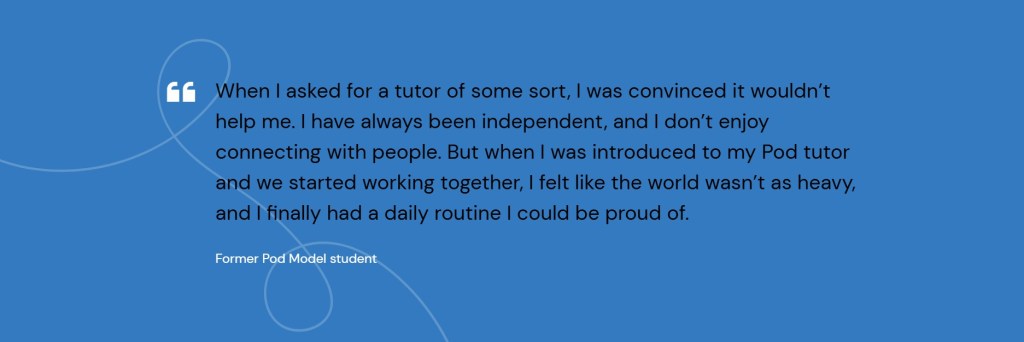
Other students showed up every single week, ready to learn. They trusted that I could help them and they were incredibly vulnerable with me. Imagine being in 10th grade and not being able to read. Your friends don’t know. Your teachers don’t know. You’re clever enough to hide it. Now imagine trusting an online tutor enough that you show up every week, right on time, just to practice reading. That is bravery.
These stories aren’t rare in Pod. They’re the reason the model works: it treats each student as whole and worthy of support, no matter where they’re starting from.
Why Pod Works for Teacher Candidates
Unlike other practicum placements, no one is randomly assigned to Pod. You must opt in. That means everyone you’re working alongside chose to be here. The result is a team of highly motivated, equity-driven educators who bring a deep sense of purpose to the work.
As a first-year BEd student, I joined a team that included second-years who had already been doing the work for months. Instead of one associate teacher overseeing my practicum, I was able to collaborate with and draw wisdom from an amazing group of my peers, second year students, social workers and educators (with years of experience both in teaching and admin positions). It was an amazingly rich professional environment to be apart of.
I am often asked if I think Pod actually prepared me to work in a classroom: absolutely i do! It’s a different experience not a lesser one.
Things traditional practicums provide that Pod doesn’t:
- ❌ Build classroom management skills
- ❌ Practice lesson planning
- ❌ In person teaching experience
Things Pod provides that traditional practicums don’t:
- ✅ Focus on one-on-one student relationships
- ✅ Gain virtual teaching experience
- ✅ Build trauma-informed teaching skills
- ✅ Student confidentiality and documentation
- ✅ Differentiation! Differentiation! Differentiation!
Additionally, as a uOttawa BEd student I will complete two different practicums. I am very excited for my next practicum where I will be able to learn everything I didn’t in Pod. But I now have experiences, insights, and training most teachers don’t get until much later (if ever) thanks to Pod.
When you’re not tutoring the Pod team also organises an incredible lineup of workshops and certifications for all the teacher candidates. Many of which I think should be an essential part of every BEd program.
Professional Development in Pod Program
Certifications:
- Suicide Prevention Certification – ASIST
- Non-Violent Crisis Intervention Certification – CPI
- 2SLGBTQIA+ inclusion training – Gender Bandit
Training Session with Experts:
- Substance Use Health & Stigma – CAPSA
- NaloxoneCare
- Trauma Informed Pedagogy
- Special Education & Understanding IEPs
- Fetal Alcohol Spectrum Disorder
- Anti-Human Trafficking
- Virtual Learning Tools
Workshops with Pod Leaders:
- Children’s Aid Society 101
- Children’s Aid Society – Understanding Signs of Safety
- Decolonization in Schools
- Student Confidentiality & Privacy Training
- Alternative Evaluation Methods & Differentiation
- Alternative Graduation Pathways
- Understanding Credit Summary Reports
- And more…
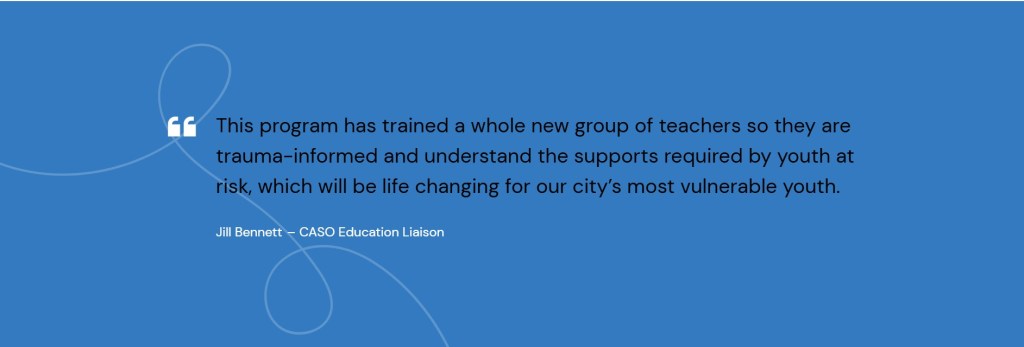
I now feel more prepared to support students with complex needs, not years down the line in my career, but now, at the very beginning. That kind of professional development is hard to come by in a traditional placement.
Why Pod Works for Schools
Teachers are tasked with serving each and every student but our education system wasn’t built with every student in mind. Both Canada’s education system and foster care system are rooted in colonial structures. Our schools were never designed to support Indigenous students, racialized students, disabled students, or youth in care. That legacy still shapes our schools today. If we want to change outcomes, we need to change structures. Decolonization isn’t an add-on to equity work, it’s at the heart of it.
Too often, students fall through the cracks of these faulty systems. Pod is trying to be a safety net that catches them. It works because it allows for flexibility, individualization, and care. But the fact that Pod is needed at all speaks to how urgently our education system needs reimagining.
Take this example…
One of my students had completed every required Grade 12 course and was ready to graduate. But because they hadn’t written the Ontario Secondary School Literacy Test (waived during the pandemic but later reinstated) they were told they needed to take a full literacy course just to get their diploma.
Despite their success in multiple senior English classes, the policy left them stuck. Through Pod and in partnership with Launch Secondary School (OCDSB SWAC), we found another way. I am guiding the student through the Ontario Literacy Course over two one-hour sessions, documenteing the curriculum expectations, and submitting everything for credit. They will graduate: not because we lowered the bar, but because we recognize and are validating the learning they had already done.
Pod allows us to support students in ways the system often can’t. But it shouldn’t have to. Until we build an education system that is fully resourced, fully inclusive, and intentionally decolonized, models like Pod will remain essential. Not as a luxury, but as a lifeline.
Final Reflections
Pod didn’t just help me become a better teacher, it changed the way I think about education.
It taught me that relationships come before curriculum. That flexibility is not a compromise, it’s a strength. That equity work isn’t a bonus but rigorous, structured, and deeply necessary. And that some of the most meaningful teaching can happen outside the four walls of a classroom.
If you’re a teacher candidate and have the chance to do Pod: I say take it! It will challenge you. It will stretch you. And it will push you to grow in ways no traditional placement can.
If you’re a administrator or policymaker: support more programs like this! Build them. Fund them. Because our students don’t just need us to believe in equity. They need us to embed it in the very structure of our education system.
The students in our care deserve nothing less.
 Katelyn Day