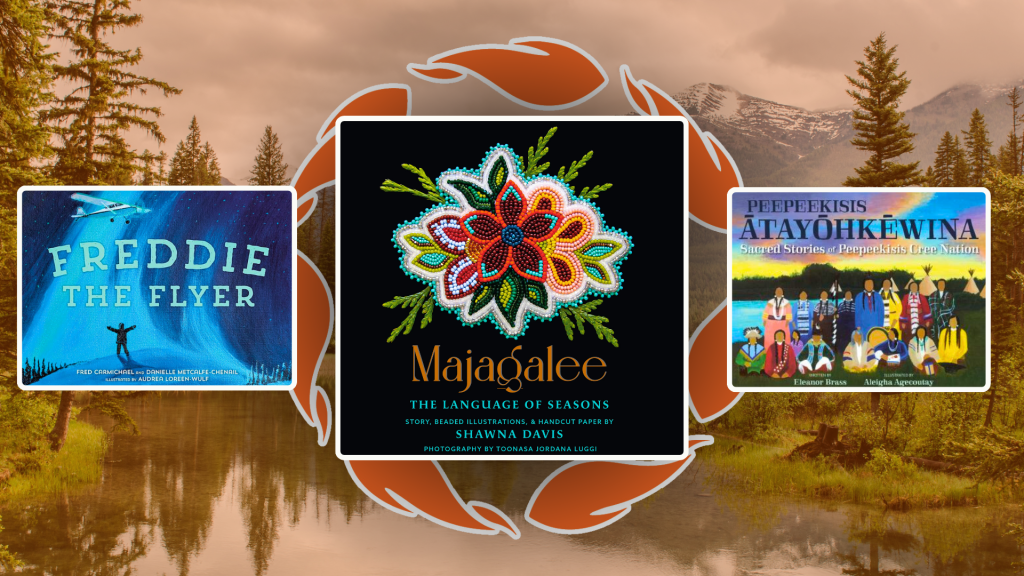
The PDF below was created for the Literature & Arts class during the first year of my Bachelor of Education.



Introduction
The Truth and Reconciliation Commission has called on Canadian educators to play a vital role in addressing the historical and ongoing impacts of colonialism on Indigenous people (First Nations, Inuit, and Métis), particularly in light of the legacy of residential schools. As Canadian teachers, we have a responsibility (and curriculum mandate) to incorporate Indigenous perspectives, histories, and cultures into our classes. Using Indigenous stories and books in the classroom helps students develop a more accurate and inclusive view of Canada’s history and current culture. The three picture books below showcase a variety of Indigenous voices, art and culture in a manner accessible to junior students.
General Curriculum Connections
The Ontario Language and Arts curriculums require that texts from diverse cultures and communities are taught. Furthermore, the updated 2023 Language curriculum requires that specifically Indigenous perspectives, cultures and stories be taught in the junior classroom. All three texts presented below fulfil these requirements individually but are even stronger when paired together as each represents a unique Indigenous community in Canada.
Language 2023 | Grade 4
A3.3 First Nations, Métis, and Inuit Perspectives and Ways of Knowing – Explain themes explored in First Nations, Métis, and Inuit cultures to demonstrate an understanding of the varied identities, perspectives, relationships, legacies, truths, and ways of knowing, being, and doing.
C1.7 Indigenous Context of Various Text Forms – Read, listen to, and view various forms of texts by diverse First Nations, Métis, and Inuit creators to make meaning through Indigenous Storywork about First Nations, Métis, and Inuit histories, cultures, relationships, communities, groups, nations, and lived experiences
C3.7 Indigenous Contexts – Explain how texts created by First Nations, Métis, and Inuit individuals, communities, groups, or nations are influenced by historical periods, cultural experiences, and events, and how they relate to current lived experiences
Arts 2009 | Grade 4
D3. Visual Arts – Exploring Forms and Cultural Contexts
Demonstrate an understanding of a variety of art forms, styles, and techniques from the past and present, and their sociocultural and historical contexts.
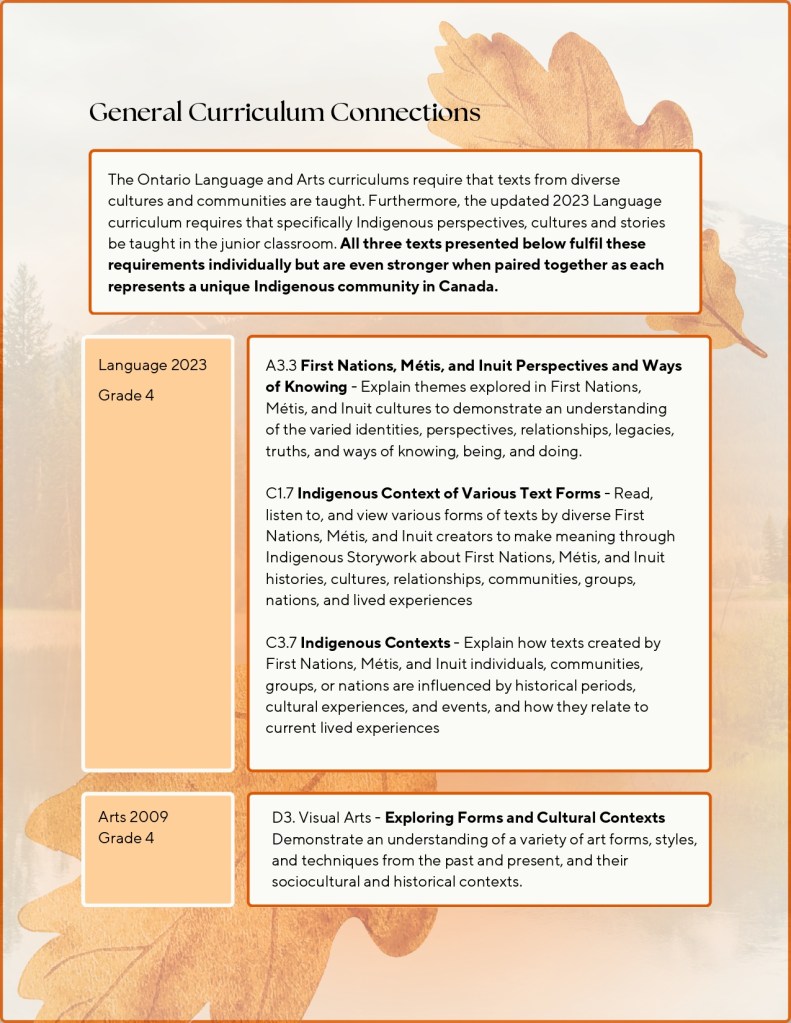
Majagalee – The Language of Seasons
Story & Beaded Illustrations: Shawna Davis
Photography: Toonasa Jordana Luggi
Genre: Picture Book & Poetry
Summary
This picture book takes readers on a vibrant journey through the four seasons. Exploring changes in nature from the perspective of the Gitxsan people – a First Nations group located in British Columbia. Shawna Davis, a Gitxsan poet and beadworker, uses her poetry to pass down the traditional Adaawk (oral history) of her people. Each two-page spread pairs a stanza of Davis’s poetry with photographs of her intricate beaded artwork, she explains “Beadwork is very special to me and tells the story within the story. I started this project holding all of my relatives close.” Bead art plays a vital role in many First Nations cultures, serving as a form of storytelling and cultural preservation. Through the beautiful blend of poetry, language, and visual art, Majagalee offers a rich celebration of Gitxsan heritage, nature, and the passing of seasons. Additionally, the Gitxsan language is used throughout the book, along with a helpful pronunciation guide, making the text a valuable contribution to the preservation of Indigenous languages.
Why for junior learners
Although picture books are often used in primary classrooms, Majagalee is ideal for junior students due to its complexity and depth. The short, digestible poem segments are rich with symbolism and meaning, making it a perfect choice for a poetry unit. The mixed-media artwork, featuring Shawna Davis’s intricate beadwork combined with collage, handcut paper, and natural elements like pine needles, rocks, leaves, and berries, is visually stunning and layered with texture. Each page offers opportunities for deep reflection and discussion, prompting students to explore connections between the art and the poetry.
Classroom Activities
Mixed Media Art Project – Inspired by the artwork in the text, provide students with a variety of materials to make their own nature-inspired mixed media art pieces. Focus on the use of texture in the artwork. More advanced students may be able to create simple beadwork for their pieces. A nature walk would be a great addition to this project: take students outside and have them pay attention to the nature they see, allowing them to collect some natural elements for their artwork.
Descriptive Nature Poems – Inspired by the poetry in the book have students create their own nature poems in small groups. Focus on the use of descriptive language. This activity would also pair well with the art project described above.
Additional Curriculum Connections
Language 2023 | Grade 4
C3.1 Literary Devices – Describe literary devices, including personification and anthropomorphism, in a variety of texts, and explain how they help create meaning and are appropriate for the intended purpose and audience
D1.1 Purpose and Audience – Identify the topic, purpose, and audience for various texts they plan to create, and explain why the chosen text form, genre, and medium suit the purpose and audience and how they will help communicate the intended meaning
D2.1 Producing Drafts – Draft texts of various forms and genres, including narrative, persuasive, and informational texts, using a variety of media, tools, and strategies
Arts 2009 | Grade 4
D1.4 Use a variety of materials, tools, and techniques to determine solutions to design challenges (e.g.mixed media).
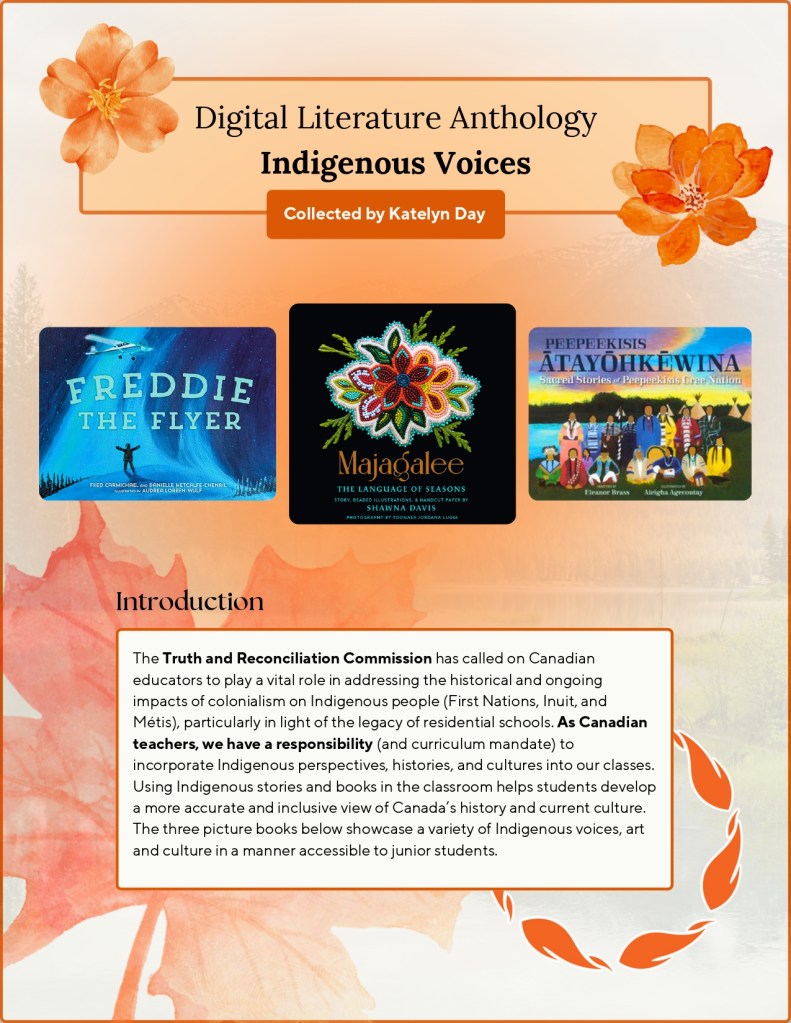
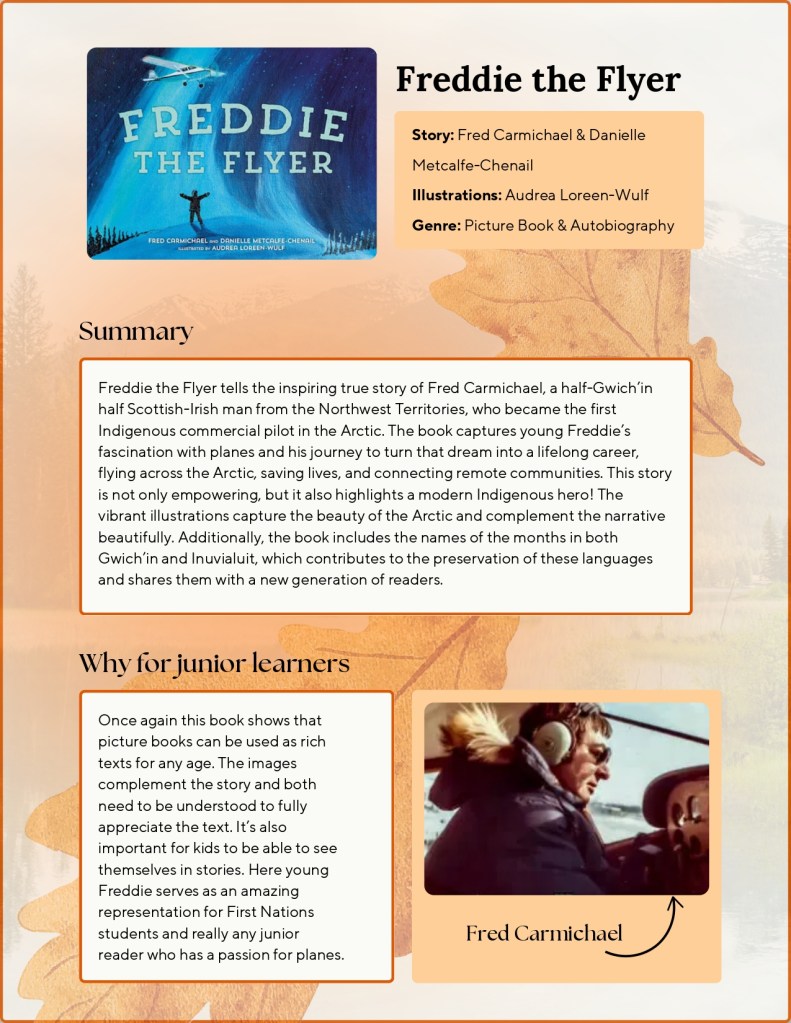
Freddie the Flyer
Story: Fred Carmichael & Danielle Metcalfe-Chenail
Illustrations: Audrea Loreen-Wulf
Genre: Picture Book & Autobiography
Summary
Freddie the Flyer tells the inspiring true story of Fred Carmichael, a half-Gwich’in half Scottish-Irish man from the Northwest Territories, who became the first Indigenous commercial pilot in the Arctic. The book captures young Freddie’s fascination with planes and his journey to turn that dream into a lifelong career, flying across the Arctic, saving lives, and connecting remote communities. This story is not only empowering, but it also highlights a modern Indigenous hero! The vibrant illustrations capture the beauty of the Arctic and complement the narrative beautifully. Additionally, the book includes the names of the months in both Gwich’in and Inuvialuit, which contributes to the preservation of these languages and shares them with a new generation of readers.
Why for junior learners
Once again this book shows that picture books can be used as rich texts for any age. The images complement the story and both need to be understood to fully appreciate the text. It’s also important for kids to be able to see themselves in stories. Here young Freddie serves as an amazing representation for First Nations students and really any junior reader who has a passion for planes.
Classroom Activities
Expand the Story – In the text, very exciting events happen on a single page in only a couple of sentences. As a creative writing exercise have students expand on one of these events in several paragraphs. Encourage the class to research what life is like in the arctic and put themselves in Freddie’s shoes.
Canadian Landscapes – Introduce the class to many examples of Canadian landscape art from both Indigenous and non-Indigenous artists. Freddie the Flyer could serve as an example of arctic landscapes. Have students identify what they like and don’t like about the art pieces. Then have them paint their own!
Additional Curriculum Connections
D1.3 Research – Gather information and content relevant to a topic, using a variety of sources and strategies, and record the sources of information
D1.4 Organizing Content – Select and classify ideas and collected information, using appropriate strategies and tools, and sequence content, taking into account the chosen text form, genre, and medium
Language 2023 | Grade 4
D1.3 Research – Gather information and content relevant to a topic, using a variety of sources and strategies, and record the sources of information
D1.4 Organizing Content – Select and classify ideas and collected information, using appropriate strategies and tools, and sequence content, taking into account the chosen text form, genre, and medium
Arts 2009 | Grade 4
D1.2 Demonstrate an understanding of composition, using selected principles of design to create narrative art works or art works on a theme or topic
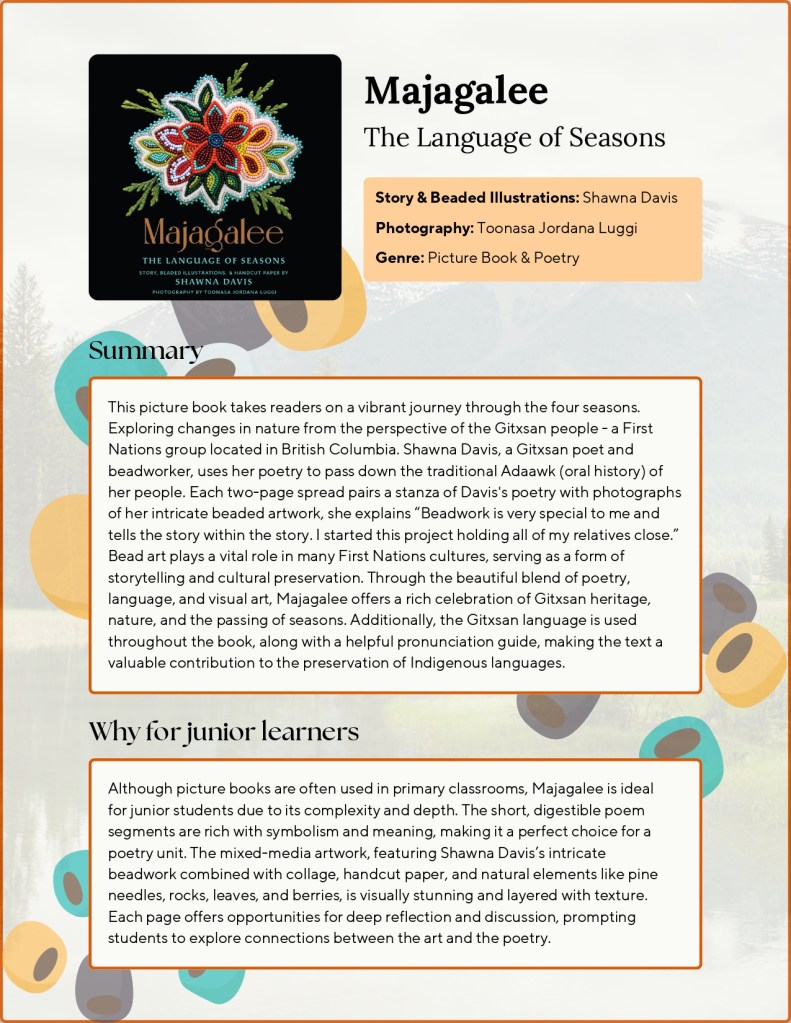
Peepeekisis ātayōhkēwina – Sacred stories of Peepeekisis Cree Nation
Written by: Eleanor Brass
Illustrated by: Aleigha Agecountay
Summary
This collection of traditional tales from the Peepeekisis Cree Nation, located in southern Saskatchewan, offers a captivating glimpse into Cree culture and storytelling. The Cree are the largest and most diverse group of First Nations peoples in Canada, but their language and stories have been systematically targeted for erasure by the Department of Indian Affairs. This makes the bilingual format of the book, which includes both English and Plains Cree, especially significant. As the author, Eleanor Brass, states: “I am hoping that our Indian culture will not be lost, that there will always be someone to write and speak about it.” The book includes a pronunciation guide, helping readers to preserve and understand the Plains Cree language. These sacred stories are fantastical yet grounded, drawing young readers into a world of wonder and excitement while conveying important cultural lessons. Each tale is paired with an illustration by Aleigha Agecountay, a young Plains Cree artist inspired by the tradition of Indigenous artists before her including Alex Janvier and Christi Belcourt, adding a playful beauty to these timeless tales.
Why for junior learners
Folk stories of all different cultures are great for teaching junior classrooms. The stories are fun and engaging yet layered with meaning and morals. Stories could be read aloud to the class or read individually by students.
Classroom Activities
Oral Story Telling – Discuss the importance of oral storytelling to Indigenous cultures and cultures around the world. In small groups have students select one story from the book and practice an oral presentation. Next, have all the groups present in front of the class. This is best done in a circle with the presentation group in the center as most indigenous teaching is done.
Indigenous Artwork – Are there any indigenous artists in your community? The best way to teach about Indigeneity is by inviting speakers into your classroom. Have a local artist come talk to your class and run a workshop. Make sure to compensate them for their time in whatever way you can.
Additional Curriculum Connections
Language 2023 | Grade 4
B1.4 Oral and Non-Verbal Communication Strategies – Identify and use oral and non-verbal communication strategies, including expression, gestures, and body language, and explain how these strategies help them understand or communicate ideas and meaning
Arts 2009 | Grade 4
D – Visual Arts. Project Dependant
References
Education for reconciliation. (May 2024). Government of Canada. https://www.rcaanc-cirnac.gc.ca/eng/1524504501233/1557513602139
Curriculum and Resources. (2024). Government of Canada. https://www.dcp.edu.gov.on.ca/en/
O’Connor, J. (2024, September 19). CKLB Radio. https://cklbradio.com/2024/09/19/beaufort-delta-aviation-pioneers-story-has-soared-into-the-hearts-of-readers/
Cree map simple. (2019, December 10). Wikipedia Commons. https://commons.wikimedia.org/wiki/File:Cree_map_simple.svg
 Katelyn Day
