Credit to Canva Creative Studios for the template design. Major edits were made by Katelyn Day.
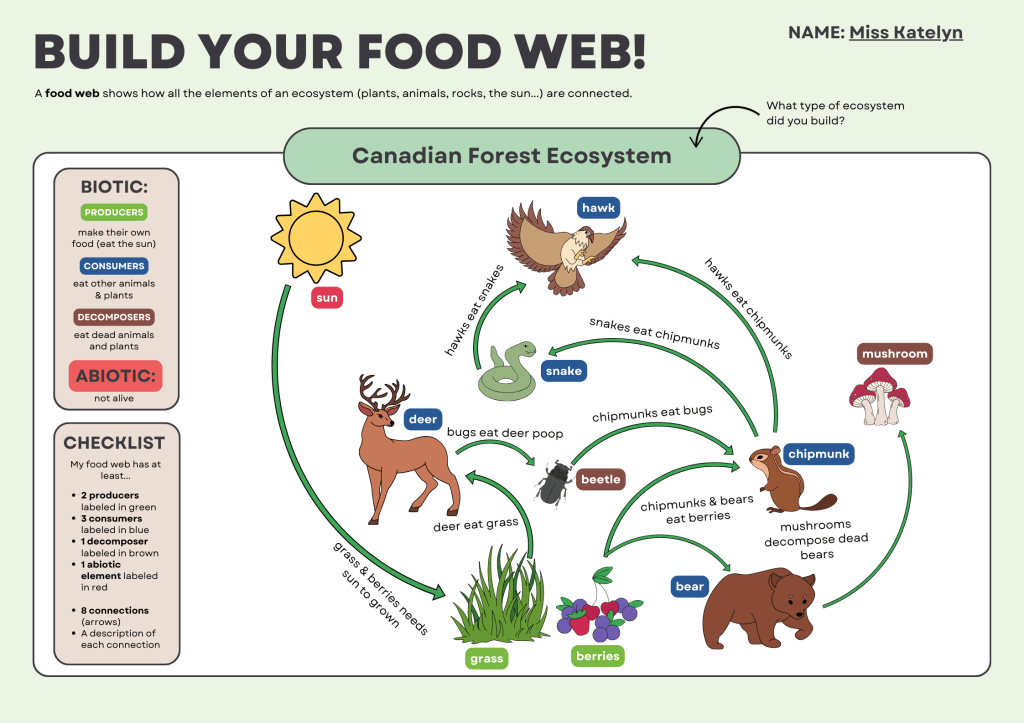
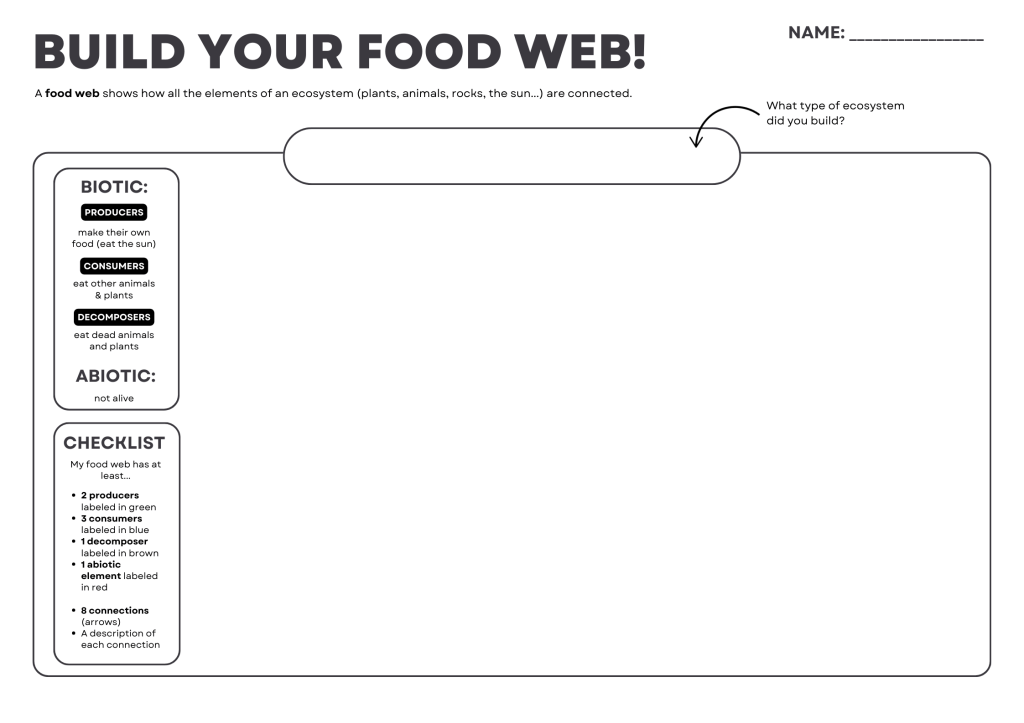
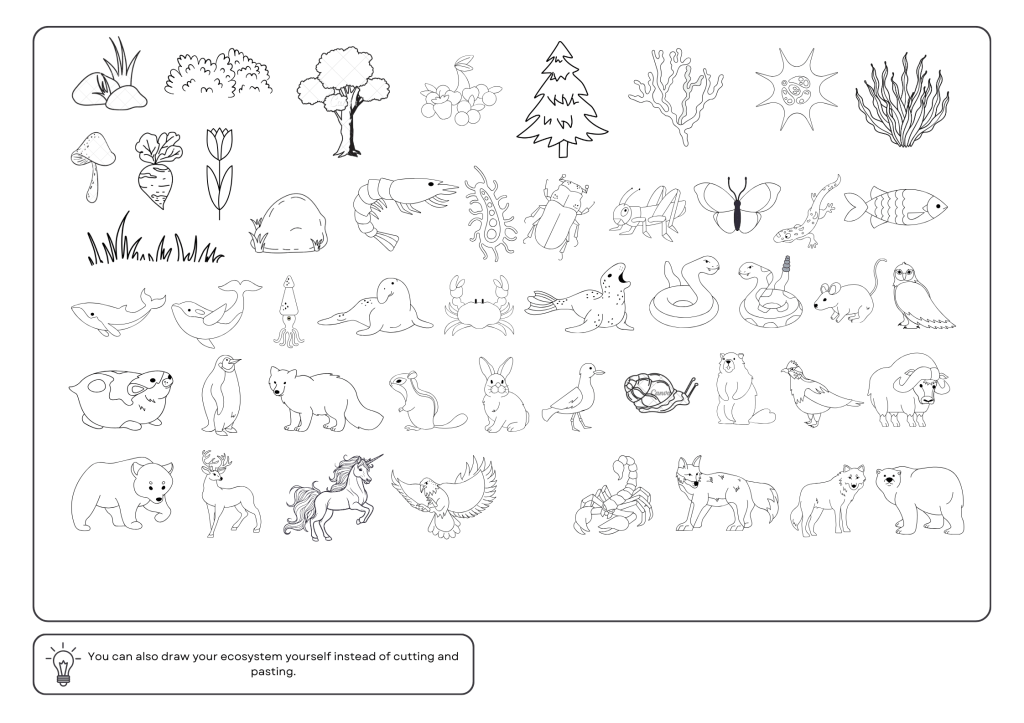
Students will create and label their own food webs to demonstrate their understanding of the preceding lesson. Students will be provided with printouts of various ecosystem elements (animals, plants, fungi…) which they will cut and paste onto their food web worksheet. Alternatively, if desired, students may draw their own elements from scratch. Students will then use coloured markers to identify each element’s role in their food web and some of the interactions between elements. Before starting the activity review the checklist with the class and show them an example of a completed worksheet.
Checklist (15 points)
Students should include the following components in their food web. Each correct item is worth 1 point.
- 2 Producers – labelled in green (using highlighters, markers, or coloured pencils)
- 3 Consumers – labelled in blue
- 1 Decomposer – labelled in brown
- 1 Abiotic Element – labelled in red
- 8 Connections (arrows) – each with a brief description explaining the nature of the connection
Assessment Criteria
This activity is designed as an assessment for learning so that the teacher can gauge how well the students understood the lesson. Grades are for the teacher’s reference only, not to be shared with students. While evaluating, teachers should keep in mind:
- Ecosystems are complex, and elements may serve multiple roles. In many cases, there will be multiple correct answers.
- Focus most on students’ explanations for each connection.
- It is impossible to include every ecosystem connection in a single food web.
Backwards Design
This assessment tool was created using backwards design; the specific expectations from the curriculum guided the development of the checklist and finally of the activity itself. This means that the assessment is a strong gauge for the student’s comprehension of the lesson.
| Specific Expectations | Assessment Tool Checklist |
|---|---|
| Grade 7 Science & Technology | |
| B2.1 explain that an ecosystem is a network of interactions among living organisms and their environment | Identify 8 connections within the food web and briefly describe each. |
| B2.2 identify biotic and abiotic components in an ecosystem, and describe the interactions between them. | The food web must contain 1 abiotic element that is labelled in red. |
| B2.3 describe roles and relationships between producers, consumers, and decomposers within an ecosystems | The food web must contain many biotic elements including: 2 producers labelled in green 3 consumers labelled in blue 1 decomposer labelled in brown |
Consolidation
This assessment is designed as a consolidation activity for the end of the lesson on food webs. The lesson introduces students to a lot of new vocabulary and this activity allows them to put it into practice. Students are not expected to have all the new vocabulary memorized which is why definitions are provided for them on the worksheets.
The students should be encouraged to colour and artistically engage with the activity. Allowing more time for students to sit with the activity will encourage deeper reflection on the content. For some students this reflection on the material with prompt them to ask more complex questions about ecosystems. For example: “Birds of prey often eat roadkill, does that mean they are decomposers?”, “Do chipmunks eat bugs!? That’s gross, I thought they only ate nuts.”, “This one type of sea slug can photosynthesize! Does that mean it’s a plant?” Encourage students to ask difficult questions, and have them discuss the answers with their peers before sharing your answers. Remember that biology is exciting and often defies definitions!
 Katelyn Day